Main types of card games – Poker, Blackjack, Bridge, Pilotta, Biriba and more.
Card games are often grouped by tradition (“poker”, “bridge”, “rummy”), but the most useful way to understand them is by how they play.
This guide gives a practical overview of the main types of card games, including poker variants such as Texas Hold’em, Omaha and Seven-Card Stud, casino games such as Blackjack and Baccarat, trick-taking games such as Bridge and Pilotta, and meld games such as Biriba.
A brief history of card games
Playing cards are widely believed to have originated in Asia (most commonly traced to China), before spreading west over time through trade routes and later developing into distinct regional traditions in the Middle East and Europe. As cards spread, different game families evolved in different places: trick-taking games became especially influential across Europe, poker developed into major variants in the United States, and many rummy/meld-style games took strong local forms across the Mediterranean, the Balkans and Latin America.
Today, card games are played worldwide in homes, clubs, casinos and social settings, with local rules and preferred formats often varying by region.

Why card game types matter
Grouping card games by type helps with three practical things:
- understanding the core objective quickly
- learning related games faster
- choosing practical table setup details (cards, chips, accessories) without guesswork
For example, if you already know one poker variant, moving to another poker variant is much easier than jumping straight into a trick-taking partnership game.
The main families of card games
There is no single universal system for classifying every card game, but most popular games fit neatly into a few broad families:
- Poker games (betting + ranked hands)
- Casino banking games (usually player vs dealer)
- Trick-taking games (win tricks by playing the best card under the rules)
- Meld/combination games (build sets and runs)
- Other families such as shedding, matching, and climbing games
This article focuses on the families most relevant to standard playing cards and popular table play.

Poker games
Poker is a family of games built around:
- betting rounds
- hidden information
- five-card hand rankings
- decision-making under uncertainty
Most variants share the same hand rankings, but the dealing format and which cards you’re allowed to use, changes the strategy significantly.
Texas Hold’em
Texas Hold’em is the most widely recognised modern poker variant.
Each player receives two private cards, and five community cards are dealt face-up in stages (flop, turn, river). Players make their best five-card hand using any combination of their private cards and the community cards.
What makes Hold’em distinct
- straightforward to learn at a basic level
- strong balance of skill, psychology, and probability
- easy to run in home games and club formats
Omaha
Omaha is a poker variant that looks similar to Hold’em at first, but plays very differently.
Players receive four hole cards instead of two, and in standard Omaha they must make a hand using exactly two hole cards and exactly three community cards.
What makes Omaha distinct
- more hand combinations in play
- stronger draws and bigger made hands are common
- hand reading can feel more complex than Hold’em
Because more combinations stay live in many pots, Omaha often feels more dynamic than Texas Hold’em.
Seven-Card Stud
Seven-Card Stud is one of the classic poker variants and remains important for players who want a broader understanding of poker.
Unlike Hold’em and Omaha, there are no community cards. Players receive a mix of face-up and face-down cards over several betting rounds and make the best five-card hand from the seven cards they receive.
What makes Stud distinct
- visible upcards create a very different information game
- memory and observation matter more
- table pace and betting rhythm feel different from community-card poker
Casino banking games
These games are usually played against the dealer (or bank) rather than directly against other players.
Blackjack
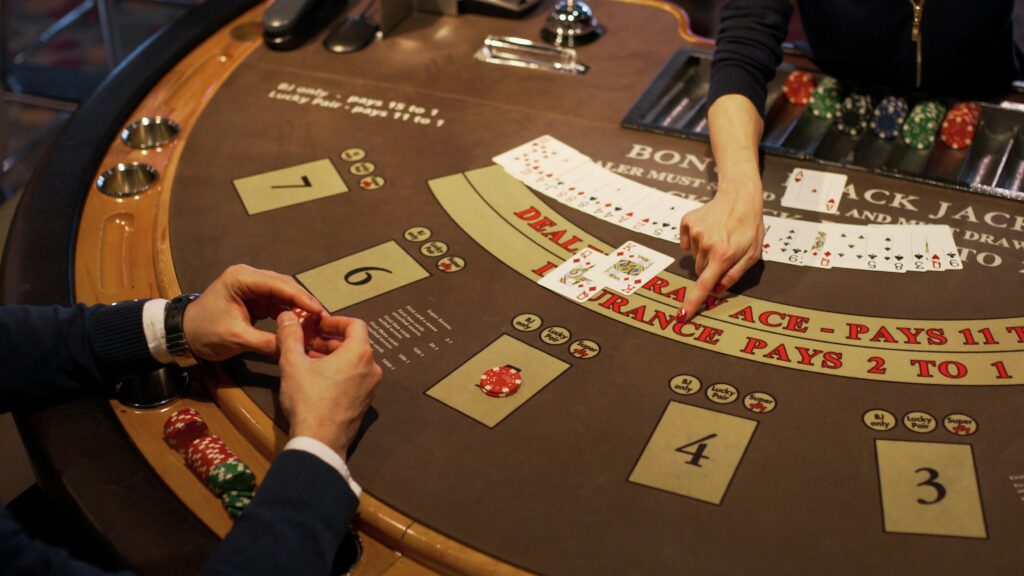
Blackjack is the best-known casino card game. The basic objective is to beat the dealer by getting closer to 21 without going over. Aces count as 1 or 11, face cards count as 10, and number cards count at face value.
What makes Blackjack distinct
- player decisions are simple in form (hit, stand, split, double) but strategic in practice
- fast rounds
- easy to learn casually, with depth for regular players
Baccarat
Baccarat is commonly played in the Punto Banco format. Players bet on which hand will win – Player, Banker, or Tie – with the goal of finishing closest to 9.
What makes Baccarat distinct
- simple betting options
- fast, structured dealing
- more about game flow and betting choice than card-hand construction
Trick-taking games
In trick-taking games, players usually play one card each to a “trick”, and the winner of the trick is determined by suit-following and ranking rules. This is one of the largest and oldest families of card games.
Bridge
Bridge is a partnership trick-taking game with two major phases:
- Bidding (auction) – players compete to set the contract
- Play of the hand – players try to make (or defeat) that contract through trick play
A central rule in play is that if you can follow suit, you must follow suit. Bridge also has the declarer/dummy structure, which makes it tactically unique from many other trick-taking games.
What makes Bridge distinct
- deep partnership communication (through bidding conventions)
- long strategic learning curve
- strong club and competitive scene globally
Pilotta or Belote
Pilotta is a Greek point-trick partnership game, and it sits within the wider Belote/Jass family of card games. It is particularly popular in Cyprus and the Mediterranean.
Belote itself is most closely associated with France, where it became one of the country’s best-known card games, and it has spread widely with regional variations in other countries. Variants and related forms are played across parts of Europe and beyond, with local names and rule differences.
What makes Pilotta distinct
- partnership play
- point-based trick-taking
- strong social and regional playing culture
- familiar family resemblance across variants, but meaningful local rule differences

Meld / combination games
These games focus on building valid combinations – typically sets (same rank) and runs (consecutive cards in suit) – rather than betting or trick-taking.
Biriba
In Biriba, the key objective is to build scoring combinations on the table, usually through sets of equal rank and runs of consecutive cards in the same suit. Rules vary by region, and those variations can materially affect strategy.
What makes Biriba distinct
- table-building play (melds stay visible)
- partnership possibilities in many versions
- regional rule differences that materially affect strategy

Other families
Other common families include shedding games (where the goal is to get rid of all your cards first), matching games (built around pairing cards by rank, suit, or symbol), and climbing games (where players beat the previous play with a higher combination or rank pattern). These families are especially common in casual, social, and regional play, and many have strong local variations. We are not covering them in detail here, but they are an important part of the wider card game landscape.
Choose game by player count
Player count is one of the quickest ways to narrow down what will feel “right” at the table.
2 players
- Blackjack (head-to-head vs dealer is the standard format)
- Biriba (often played two-handed in some versions)
- Gin Rummy (two-player meld game)
3-4 players
- Texas Hold’em (works well from 3-4 upwards)
- Omaha (best for 4+; plays bigger with more players)
- Seven-Card Stud (very playable in small groups)
- Bridge (exactly 4)
- Pilotta / Belote (typically 4 as a partnership game)
5-8 players
- Texas Hold’em (classic home-game range)
- Omaha (action-heavy in mid-size groups)
- Seven-Card Stud (often best before the table gets too large)
9+ players
- Texas Hold’em (common for larger home games and events)
- Blackjack (as a group game with one dealer role)
- Baccarat (naturally accommodates a larger rail of bettors)
Choosing cards for different game types
The same deck can work for many games, but certain formats are often more comfortable depending on how the game is played.
For poker games (Hold’em, Omaha, Stud)
Common preferences often include:
- poker-size cards (wide)
- big indexes (jumbo)
For casino banking games (Blackjack, Baccarat)
Common preferences often include:
- easy-to-read cards (wide size)
- clear indexes for quick recognition during faster rounds (standard or jumbo, depending on table visibility)
For trick-taking games (Bridge, Pilotta)
Common preferences often include:
- comfortable handling for longer sessions (narrower/bridge-size cards)
- traditional suits/ranks (standard index)
For meld games (Biriba and other)
Common preferences often include:
- easy sorting and fanning (narrow size)
- good readability across many cards in hand (standard index)
Build a card setup that fits how you play
Explore our collection of premium playing cards, casino chips, and table accessories – selected for feel, durability, and the kind of details that improve play at home, in clubs, and at events.
If you’re planning a full poker build (home game or venue), contact us with your brief and we’ll propose a complete, premium setup.