
Backgammon Rules – How to Set Up, Play and Win
Backgammon is a two-player board game of movement, timing and risk. The aim is simple: move all 15 of your checkers around the board, bring them into your home board, then bear them off before your opponent does.
This guide explains the standard rules of backgammon, including board setup, movement, hitting, re-entering, bearing off, gammons, backgammons and the optional doubling cube. Some clubs, tournaments and regional formats may use additional conventions, especially around the doubling cube and match play.
Quick Summary: How Backgammon Works
Backgammon is played by two players. Each player has 15 checkers and moves them in opposite directions around a board of 24 points.
On your turn, you roll two dice and move your checkers according to the numbers shown. You may move one checker using both dice, or two different checkers using one die each, provided each individual move is legal.
Once all your checkers are inside your home board, you may begin bearing off. The first player to bear off all 15 checkers wins.
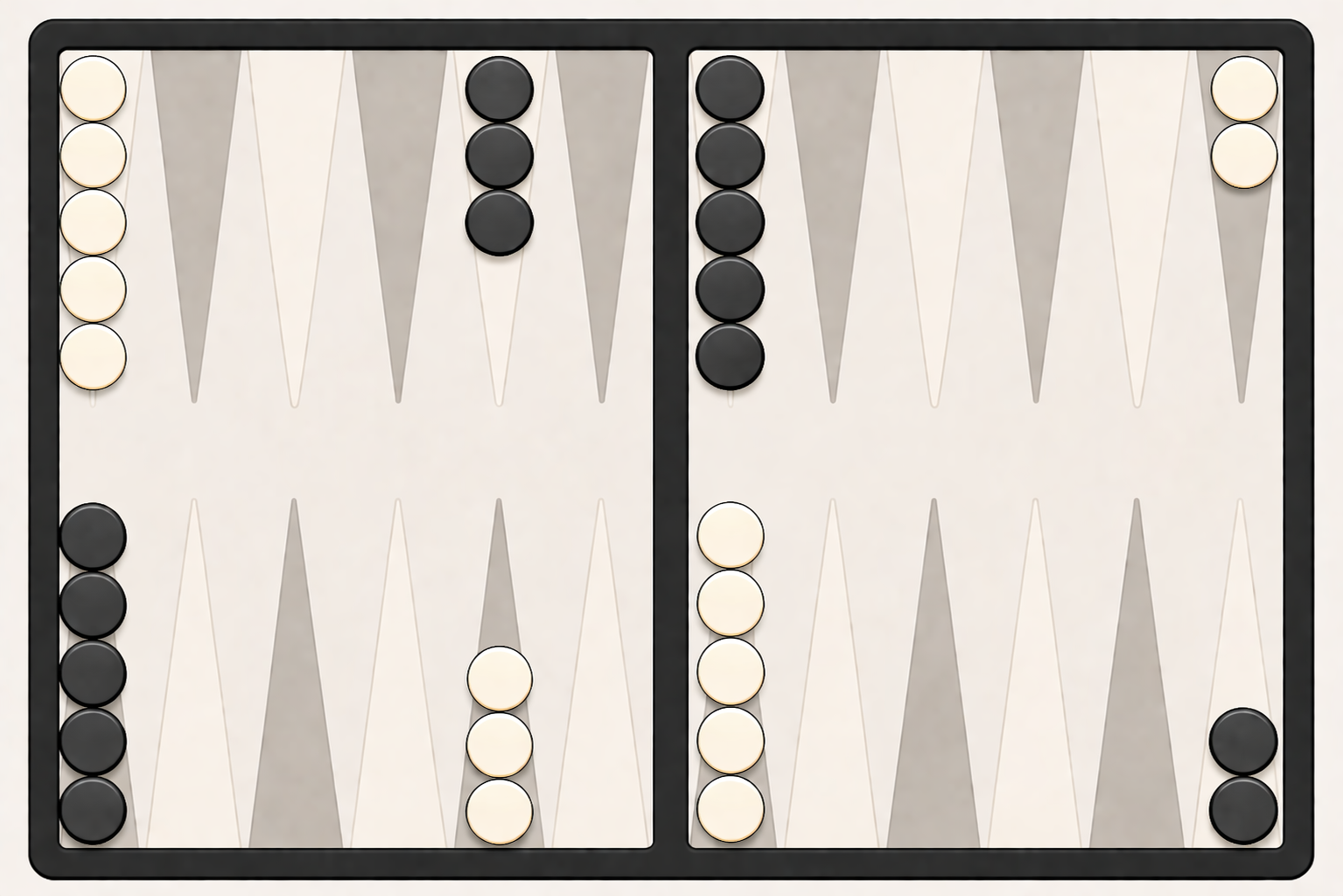
If you are setting up a new board, start with the board layout below, then follow the rules section by section.
On this page
- Backgammon board setup
- The object of the game
- How to start the game
- How movement works
- Doubles
- Hitting and re-entering
- Bearing off
- Gammons and backgammons
- The doubling cube
- Beginner FAQ
- Glossary
What You Need to Play
To play backgammon, you need:
- A backgammon board
- 15 checkers for each player
- Two dice, or one pair of dice for each player
- Dice cups, if available
- A doubling cube, optional for beginners
For a first game, you can ignore the doubling cube. Learn setup, movement, hitting and bearing off first. The cube becomes more useful once both players understand the rhythm of the game.
Backgammon Board Setup
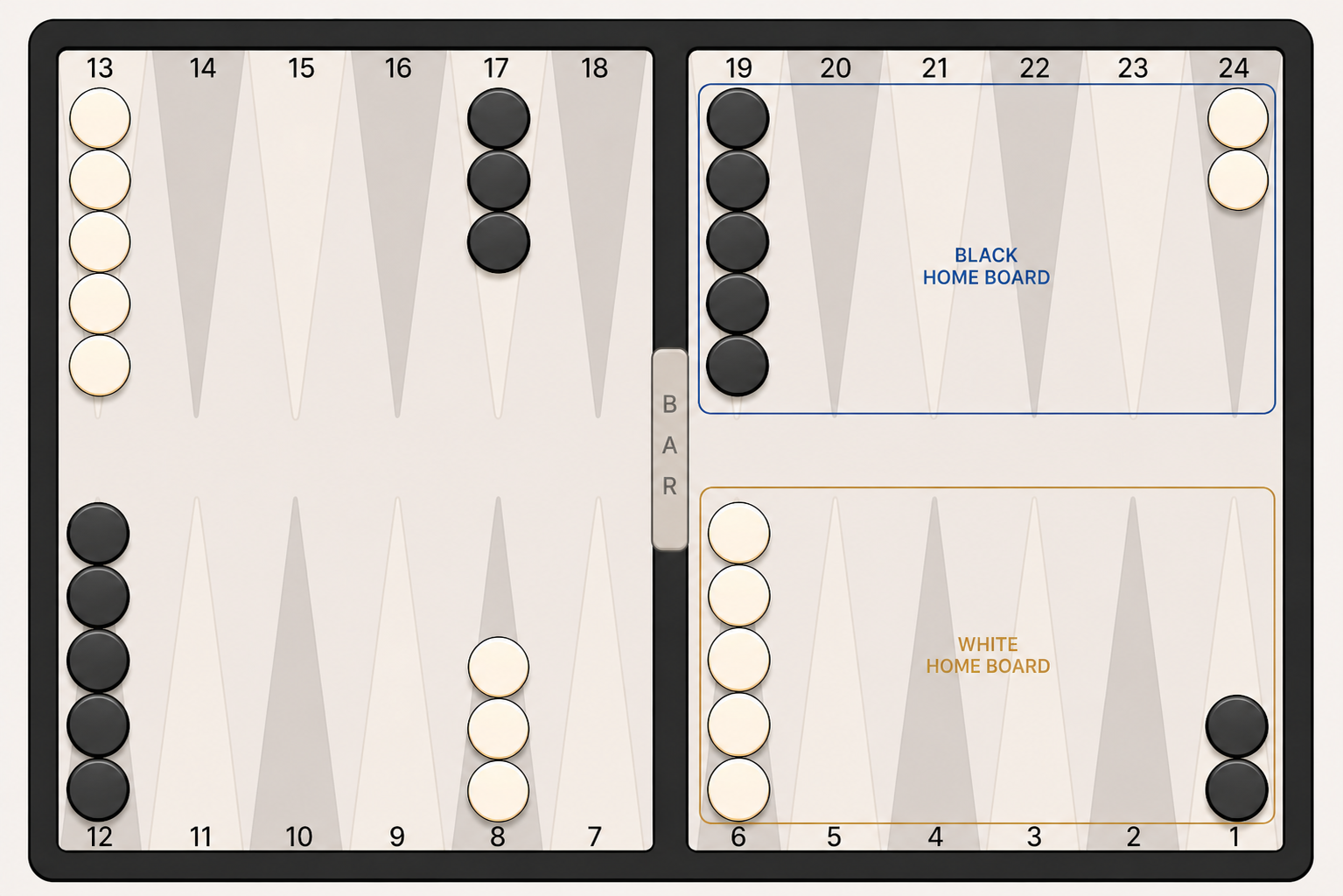
A backgammon board has 24 long triangles called points. The points are grouped into four sections:
- Your home board
- Your outer board
- Your opponent’s home board
- Your opponent’s outer board
The raised divider in the middle is called the bar.
Each player starts with 15 checkers. The standard starting position is:
- 2 checkers on your 24-point
- 5 checkers on your 13-point
- 3 checkers on your 8-point
- 5 checkers on your 6-point
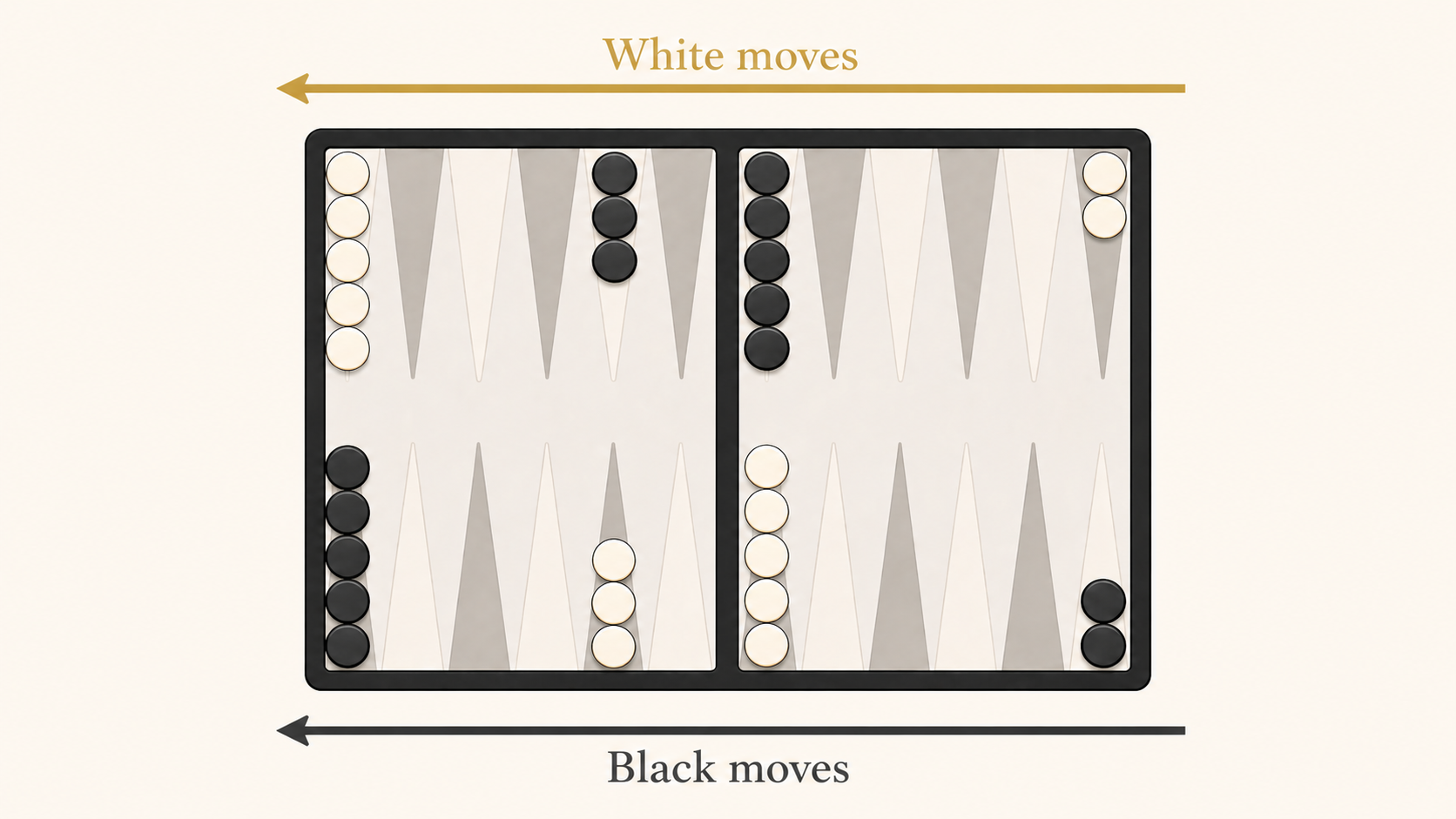
Your opponent sets up in the mirror image. You move in opposite directions, from your 24-point towards your 1-point.
Backgammon boards can be viewed from either side, so the important detail is not left or right, but direction: each player moves from their 24-point towards their 1-point.
Your home board is the final six points where you will eventually bear off your checkers.
The Object of the Game
The object of backgammon is to move all your checkers into your home board and then remove them from the board. Removing checkers is called bearing off.
The first player to bear off all 15 checkers wins the game.
How to Start the Game
At the start of the game, each player rolls one die.
The player who rolls the higher number goes first and uses both numbers rolled for the opening move. For example, if one player rolls 5 and the other rolls 3, the player who rolled 5 moves first using a 5 and a 3.
If both players roll the same number, roll again until the dice are different.
After the opening roll, players take turns rolling two dice.
How Movement Works
The two dice represent two separate moves.
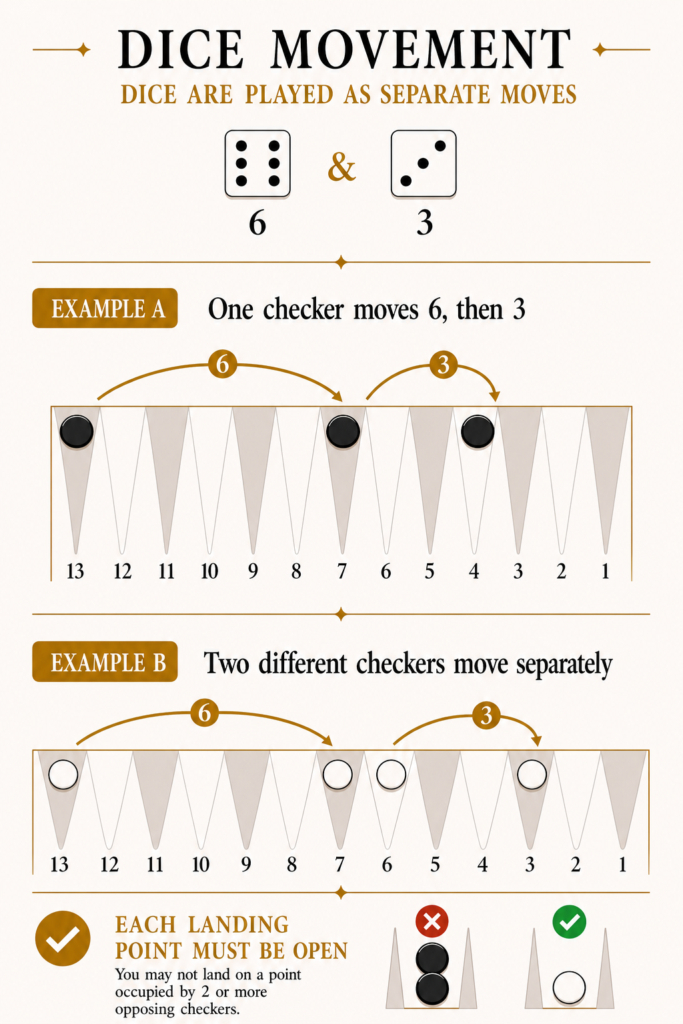
If you roll 6 and 3, you may:
- Move one checker 6 points and another checker 3 points; or
- Move the same checker 6 points and then 3 points; or
- Move the same checker 3 points and then 6 points.
When one checker uses both dice, each part of the move must be legal. You cannot simply move the total if the intermediate landing point is blocked.
For example, with a roll of 6 and 3, moving one checker 9 points is only allowed if either the 6-point landing space or the 3-point landing space along the way is open, depending on the order you choose.
Doubles
If you roll the same number on both dice, you play that number four times.
For example, a roll of 4-4 gives you four separate moves of 4 points.
You may move four different checkers 4 points each, or you may move one checker several times, if every individual move is legal.
You must use as many of the four moves as legally possible.
Doubles can be powerful, but they still follow the normal movement rules.
Open Points, Made Points and Blots
A checker may move only to an open point.
A point is open if it is:
- Empty
- Occupied by one or more of your own checkers
- Occupied by exactly one opposing checker
A point occupied by two or more opposing checkers is closed to you. You cannot land there.
A point occupied by two or more of your own checkers is often called a made point. Your opponent cannot land on it.
A single checker sitting alone on a point is called a blot. Blots are vulnerable because your opponent can land on them and hit them.
Using Both Dice Where Possible
You must play both dice if a legal move is available.
When only one die can be played, you must play that die. If either die could be played, but not both, the higher die must be played.
If no legal move is available, your turn is lost.
With doubles, you must play as many of the four moves as legally possible.
This rule matters. Backgammon is not simply about choosing your favourite move; sometimes the dice require you to play a less comfortable move because it is the only legal one.
Hitting, the Bar and Re-Entering
If you land on a point occupied by one opposing checker, that checker is hit and placed on the bar.
A checker on the bar must re-enter before that player can move any other checker.
Re-entry happens in the opponent’s home board. The dice determine which point you may enter on. For example, if you roll 4 and 2, you may re-enter on the opponent’s 4-point or 2-point, provided that point is open.
If both entry points are blocked by two or more opposing checkers, you cannot re-enter and you lose your turn.
If you have more than one checker on the bar, you must re-enter as many as possible before making any other move.
Bearing Off
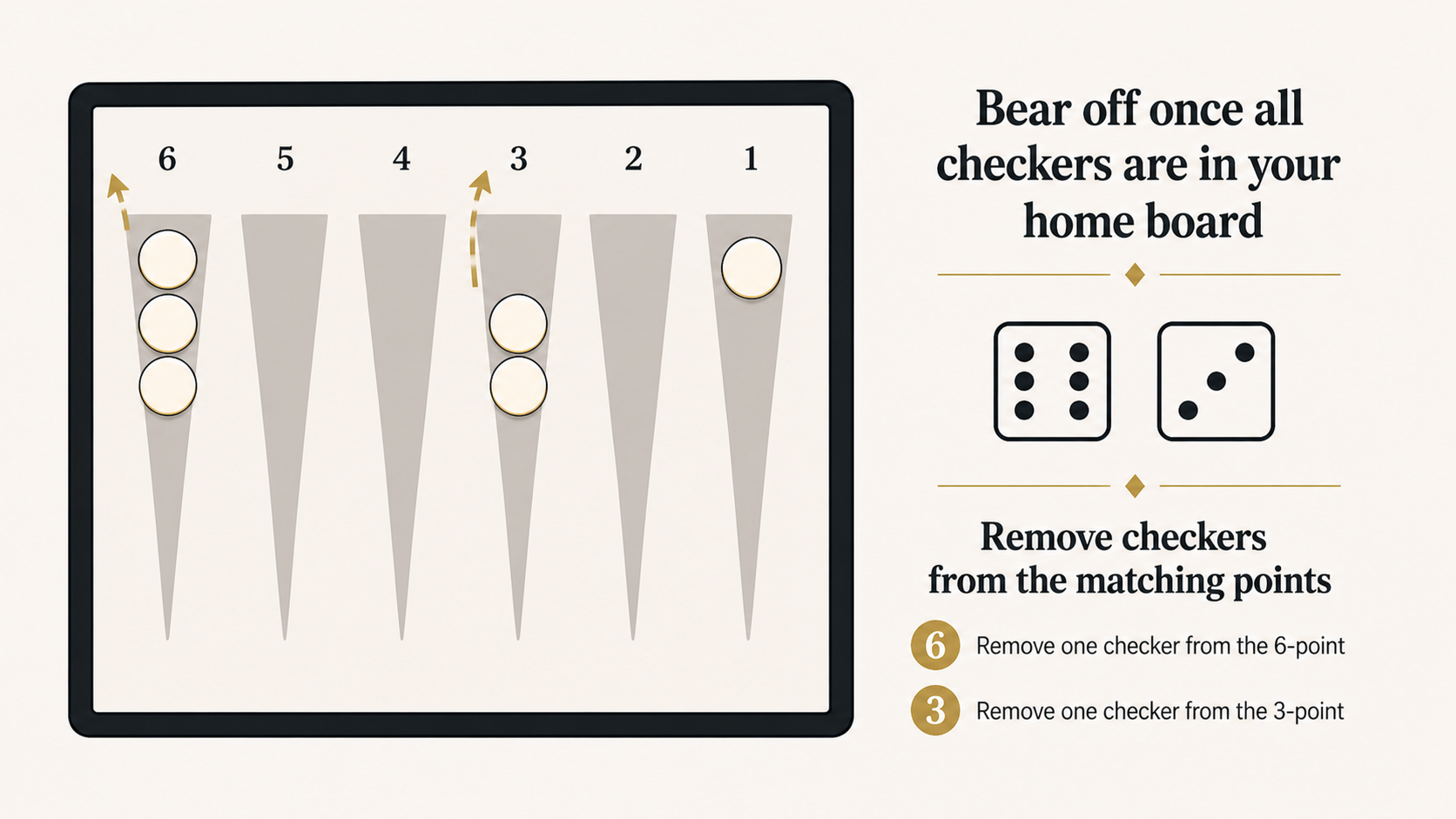
You may begin bearing off only when all 15 of your checkers are in your home board.
To bear off, roll the dice and remove checkers from the corresponding points. For example:
- A roll of 6 can remove a checker from your 6-point.
- A roll of 3 can remove a checker from your 3-point.
If you roll a number for a point that has no checker, you must make a legal move from a higher point if you can.
If there are no checkers on any higher point, you may bear off from the highest occupied point.
For example, if you roll 6 but your 6-point is empty and your highest checker is on the 5-point, you may bear off from the 5-point.
You do not always have to bear off if another legal move is available. Sometimes moving within the home board is the better play.
If one of your checkers is hit while you are bearing off, it goes to the bar. You must re-enter it, move it back around the board, and bring it into your home board again before you can continue bearing off.
Winning, Gammons and Backgammons
A normal win is worth one game point, or the current value of the doubling cube if you are using it.
A gammon happens when the losing player has not borne off any checkers. A gammon is worth double the value of the game.
A backgammon happens when the losing player has not borne off any checkers and still has a checker on the bar or inside the winner’s home board. A backgammon is worth triple the value of the game.
For casual play, players can simply count every win as one game. Once you are comfortable, gammons, backgammons and the doubling cube add another layer of judgement.
The Doubling Cube (optional)
The doubling cube is the larger cube marked 2, 4, 8, 16, 32 and 64. It is not rolled like dice. It is used to raise the value of the game.
At the start of a game, the cube sits in the centre and the game is worth 1 point.
Before rolling, a player may offer to double the stakes. The opponent then chooses:
- Take: accept the double and continue playing at the new value.
- Pass: refuse the double and concede the current value of the game.
If a player accepts a double, they take control of the cube. Only that player may offer the next redouble.
Match Play and the Crawford Rule
Backgammon can be played as single games or as a match to a set number of points, such as 3, 5 or 7.
In match play, wins, gammons, backgammons and the doubling cube all contribute to the match score.
One important match-play rule is the Crawford rule. When either player first reaches a score that is exactly one point away from winning the match, the next game is played without the doubling cube. That game is called the Crawford game.
If the match continues after that, the cube is used again.
Beginner FAQ
How many checkers does each player have in backgammon?
Each player has 15 checkers. One player usually plays with the lighter colour and the other with the darker colour.
How many points are on a backgammon board?
A backgammon board has 24 points. Each player moves around the board in opposite directions, from their 24-point towards their 1-point.
What is the correct backgammon setup?
Each player starts with 2 checkers on the 24-point, 5 on the 13-point, 3 on the 8-point and 5 on the 6-point. The opponent sets up in the mirror image.
Who goes first in backgammon?
Each player rolls one die. The higher roll goes first and uses the two numbers rolled as the opening move. If both players roll the same number, they roll again.
Can you move one checker using both dice?
Yes. You may move one checker using both dice, provided each separate part of the move is legal. The intermediate point must be open.
Can you land on your own checkers?
Yes. You may land on a point occupied by your own checkers. This is often how you build made points and protect blots.
Can you land on two opposing checkers?
No. A point occupied by two or more opposing checkers is closed. You cannot land there.
What happens when a checker is hit?
The checker is placed on the bar. That player must re-enter it into the opponent’s home board before moving any other checker.
When can you start bearing off?
You can start bearing off only when all 15 of your checkers are in your home board.
Do you have to use both dice?
Yes, if legally possible. If only one die can be played, you must play it. If either die can be played but not both, the higher number must be used.
What is a gammon?
A gammon is when the losing player has not borne off any checkers. It counts as double the value of the game.
What is a backgammon?
A backgammon is when the losing player has not borne off any checkers and still has a checker on the bar or in the winner’s home board. It counts as triple the value of the game.
Is the doubling cube required in backgammon?
No. The doubling cube is optional in casual play. It is more common in club, match and tournament play, and is usually added once both players are comfortable with setup, movement, hitting, re-entering and bearing off.
Glossary
Bar
The raised divider in the middle of the board. Hit checkers are placed on the bar.
Bear off
To remove a checker from the board once all your checkers are in your home board.
Blot
A single checker alone on a point. It can be hit by the opponent.
Checker
One of the playing pieces used in backgammon. Each player has 15.
Closed point
A point occupied by two or more opposing checkers. You cannot land there.
Doubling cube
The cube marked 2, 4, 8, 16, 32 and 64, used to increase the value of a game.
Gammon
A double-value win where the losing player has not borne off any checkers.
Backgammon
A triple-value win where the losing player has not borne off any checkers and still has a checker on the bar or in the winner’s home board.
Hit
To land on an opposing blot and send that checker to the bar.
Home board
The final six points where your checkers must gather before bearing off.
Made point
A point occupied by two or more of your checkers. Your opponent cannot land there.
Open point
A point you are allowed to land on. It may be empty, occupied by your own checkers, or occupied by one opposing checker.
Outer board
The section of the board between the home boards.
Pip
One point of movement on the board.
Point
One of the 24 long triangles on a backgammon board.
Re-enter
To bring a checker back into play from the bar.
Bring the game to the table
Explore our collection of premium backgammon sets and accessories, selected for clear layouts, comfortable pieces, durable construction and the kind of details that make play more enjoyable.
Whether you are learning the game, upgrading a home set or choosing a considered gift, our collection is curated for lasting use and a refined playing experience.